Nobody's favourite job
The angle that actually matters
Mesh generators report a handful of angle metrics; not all of them predict the same failure.

Minimum angle, maximum angle and what each one breaks — the quality metrics that mesh generators report.
What each limit actually controls
Every triangular or tetrahedral element carries angles that either compress or amplify errors. The two bounds — minimum and maximum — threaten accuracy in different ways, and conflating them is a common source of confusion when reading mesh quality reports.
A small minimum angle drives up the condition number of the element stiffness matrix. When one angle collapses toward zero the element becomes a needle: two edges nearly parallel, one very long, and the shape functions forced to vary steeply across a thin sliver. The Jacobian of the mapping from reference to physical element grows large, and that amplification feeds directly into the discretisation error. That damage shows up mainly in conditioning, since the interpolation estimate itself needs only the maximum angle to stay bounded away from 180 degrees. In practice, most codes flag elements whose minimum angle falls below roughly ten degrees, though the real threshold depends on the problem and the basis order.
The maximum angle tells a different story. For triangles, the classical result — established in work formalised by Babuška and Aziz in 1976 — is that the interpolation error bound involves the maximum angle, not the minimum. A needle-like triangle with one very small angle can still interpolate well if the maximum angle stays well away from 180 degrees. This counterintuitive result means that a small minimum angle is not automatically fatal ↗, and some valid meshes contain quite thin, needle-like triangles without measurable degradation in solution quality. Tetrahedra are less forgiving: the equivalent bound depends on the ratio of the circumradius to the shortest edge, a measure that punishes both extremes.
Beyond triangles and tets, quadrilateral and hexahedral elements introduce skew and taper alongside angle. A parallelogram-shaped quad has no angle problem but may still be poorly conditioned if its sides are very unequal. The dihedral angles between faces of a hexahedron matter for three-dimensional problems in the same way planar angles matter for triangles, and a warped hex with a non-planar face creates a non-invertible Jacobian in the worst case.
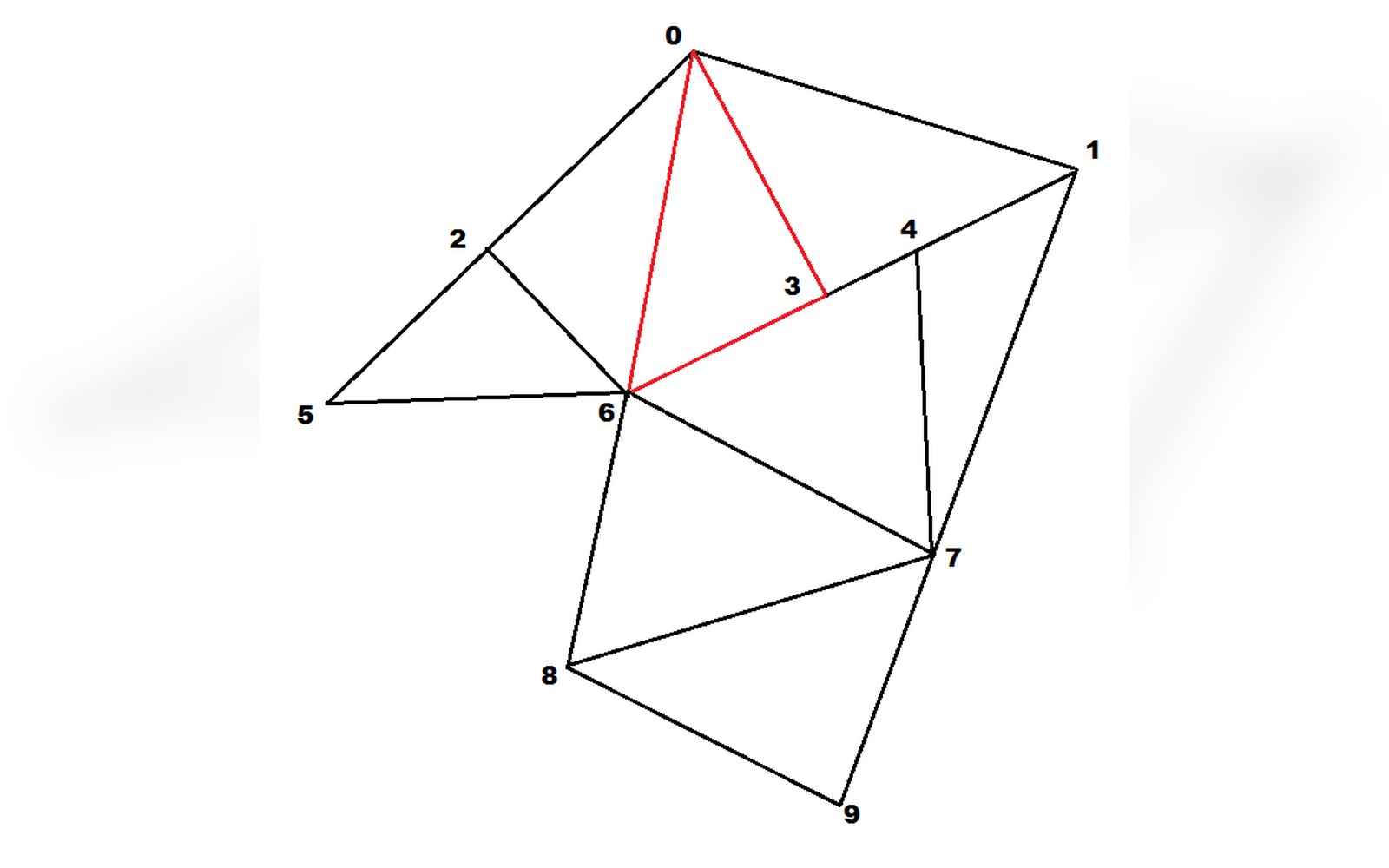
A minimum-angle bound and a maximum-angle bound rule out different shapes, and only one of them is what the interpolation estimate actually needs.
Photo: Mesh FEM · Wikimedia CommonsMesh generators typically report minimum angle, maximum angle, aspect ratio, and sometimes the Jacobian determinant scaled to the ideal element. The Jacobian determinant is the most direct indicator of elemental validity: a negative value means the element is inverted and the mapping has flipped, producing a singularity that will crash any solver. An element with a poor angle but a positive Jacobian will at least converge to something, though perhaps slowly.
The practical read: watch the minimum angle for conditioning, watch the maximum angle for interpolation order, and treat a negative Jacobian as an immediate error, not a warning.
The two bounds — minimum and maximum — threaten accuracy in different ways, and conflating them is a common source of confusion when reading mesh quality reports.
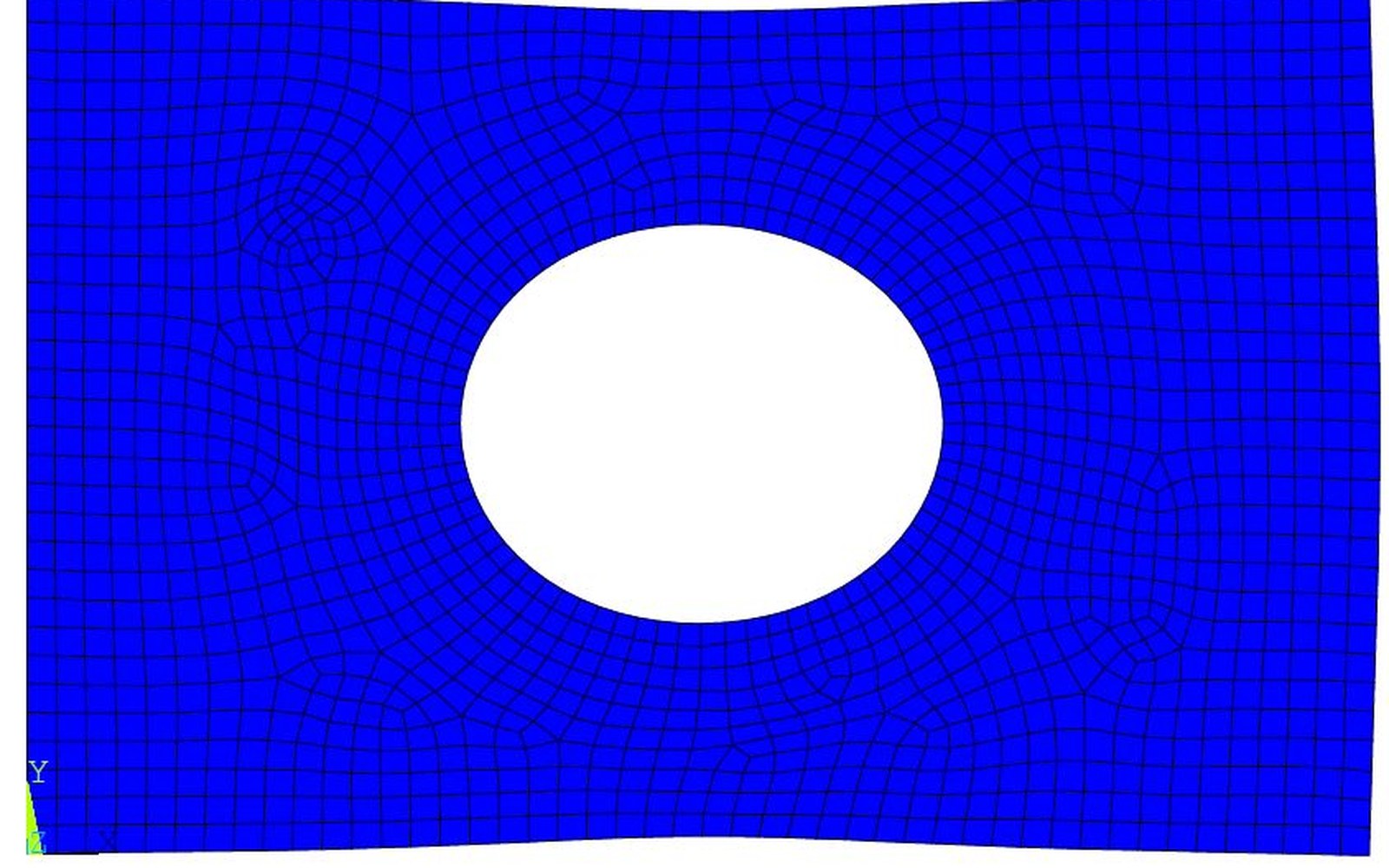
A flattened element amplifies the gradient of the interpolant along one direction, which is exactly the quantity the energy norm measures.
Photo: Meshing in Finite Element Analysis · Wikimedia Commons