Cut it into pieces
Turner, Clough, Argyris, Zienkiewicz

The 1956 paper, the parallel European work, and the textbook that turned a technique into a discipline.
The engineers who made a method
The finite element method did not emerge from a single insight. It was assembled, in parallel and sometimes in ignorance of the other parties, from structural mechanics, variational mathematics and the practical demands of jet-age aerospace. Four names mark the decisive moments: Martin Turner, Ray Clough, John Argyris ↗ and Olgierd Zienkiewicz ↗ — and the trajectory from the first of them to the last spans roughly two decades of crystallisation.
The foundational paper is Turner, Clough, Martin and Topp (1956), published in the Journal of the Aeronautical Sciences. Martin Turner was a Boeing structures engineer, and the problem motivating the paper was real and industrial: swept-wing panels under aerodynamic load, too complex to analyse by hand except in the crudest approximations. The paper introduced the stiffness matrix for a triangular plane-stress element — the direct stiffness method applied to a discretised continuum. It was not presented as a new mathematical framework; it was presented as a practical tool for aircraft designers. The language was engineering, not functional analysis, and it worked precisely because of that pragmatism. The triangular constant-strain element it described is still the baseline against which element technology is measured.
Ray W. Clough extended that work and, crucially, named it. Writing in the proceedings of the Second ASCE Conference on Electronic Computation in 1960, Clough coined the phrase "finite element method" — a phrase that gave the technique an identity separable from any one application. Clough was at Berkeley, and his group would go on to apply FEM to earthquake engineering, shell structures and eventually fluid problems, making the Berkeley structural engineering programme one of the formative centres of the discipline. Naming a method matters: it draws researchers across disciplines to a common vocabulary, and Clough's label did exactly that.
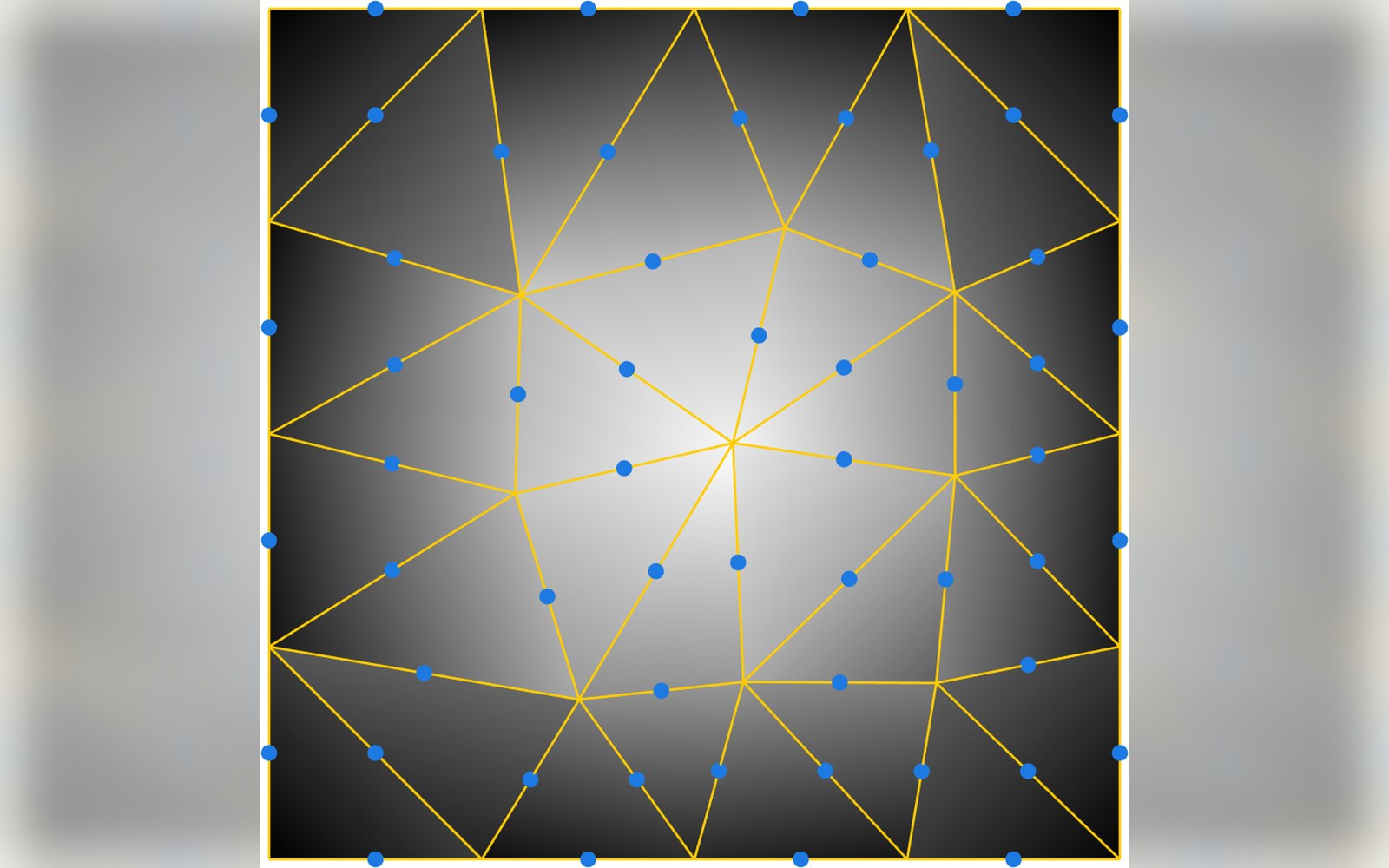
Stiffness matrices for triangular and rectangular plane-stress elements, derived from direct physical reasoning rather than from a variational principle.
Photo: Triangulation with edge midpoints · Wikimedia CommonsThe European thread
While Turner and Clough were working from structural stiffness matrices, John Argyris was approaching the same territory from energy methods and matrix structural analysis. Working first at Imperial College London and then at the University of Stuttgart, Argyris published an extended two-part series in Aircraft Engineering in 1954 and 1955 — before the Turner paper appeared — under the title "Energy Theorems and Structural Analysis." The work systematised the force and displacement methods of structural analysis into a matrix framework, laying algebraic groundwork that would underpin finite element formulations for decades.
Argyris was a prolific and sometimes difficult writer, his papers dense with notation, but the substance was rigorous and far-reaching. He later contributed the TUBA family of plate-bending elements, among the first to achieve C1 continuity — a property relevant to problems where both displacement and its gradient must be continuous across element boundaries, as in classical plate theory. His group at Stuttgart developed the ASKA (Automatic System for Kinematic Analysis) code, one of the earliest large-scale finite element programs, operational in the 1960s. Argyris is also credited with early use of the term "finite elements" in the European context, though priority arguments are largely beside the point given the parallel development.
The paper introduced the stiffness matrix for a triangular plane-stress element — the direct stiffness method applied to a discretised continuum.
The Atlantic separation mattered less than it might seem. By the early 1960s, the structural mechanics community on both sides was reading the same growing body of literature, and the 1963 paper by Melosh — connecting the direct stiffness method to the Rayleigh–Ritz procedure — made explicit that FEM was a particular implementation of a classical variational principle. That connection was what allowed the method to escape structures entirely.
The textbook and the discipline
Olgierd Zienkiewicz's contribution is of a different character: he turned a collection of techniques into a teachable, transferable discipline. His 1967 textbook The Finite Element Method in Structural and Continuum Mechanics, published by McGraw-Hill, was the first comprehensive treatment aimed at engineers rather than mathematicians. It organised element formulations, boundary conditions, numerical integration and error behaviour into a coherent whole that a graduate student could actually use. The book went through six editions over his lifetime — the later ones co-authored with Robert Taylor — expanding from structural mechanics to cover heat transfer, fluid dynamics and coupled problems, tracking the method's own expansion.
Zienkiewicz was at the University of Wales Swansea from 1961, and the department he built there became a centre of FEM research for three decades. His instinct was always toward applicability: shape functions, isoparametric elements, reduced integration, patch tests — these were not abstract exercises but answers to the question of what actually converges in practice. The patch test, introduced by Irons and Razzaque and championed by Zienkiewicz's group, gave practitioners a simple criterion for checking whether an element formulation was consistent: a necessary condition for convergence that could be verified without an exact solution. It remains a standard check in element development.
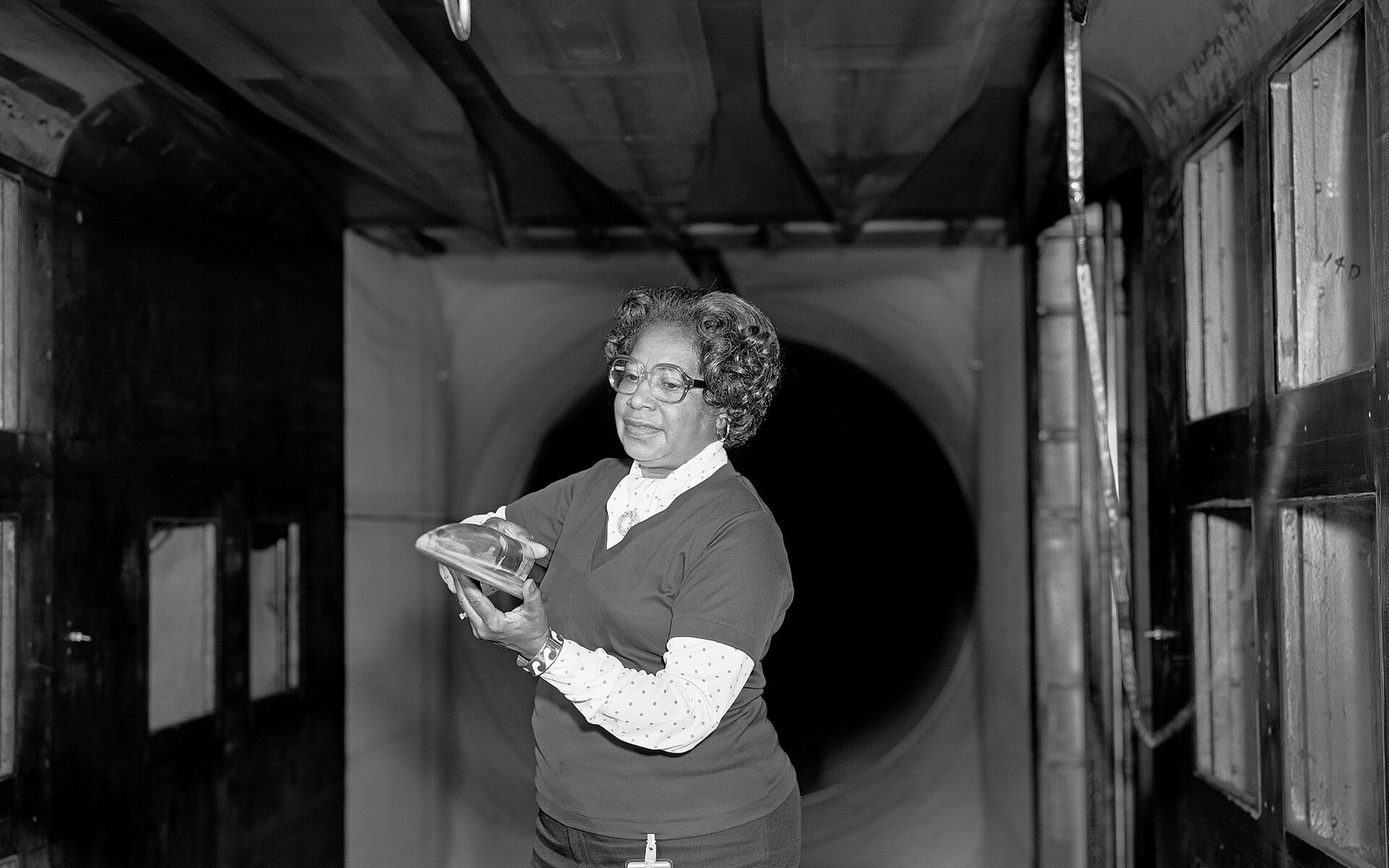
Aircraft structures were the forcing problem: swept and delta wings whose load paths no closed-form plate theory could describe.
Photo: Mary Jackson in a wind tunnel with a model at NASA Langley · Wikimedia CommonsBy the early 1970s, the method had moved irreversibly beyond structures. Zienkiewicz's group and others applied FEM to incompressible flow and coupled problems, heat conduction, geomechanics and electromagnetics, each application requiring new element families and often exposing new stability constraints. The inf-sup condition — independently articulated by Babuška and Brezzi — emerged as the mathematical criterion governing which element combinations were stable for incompressible problems, a theoretical result with immediate practical consequences for fluid analysts still visible in today's element libraries.
What the history teaches
The lineage matters because it explains the method's structure. FEM inherits from Turner and Clough its engineering pragmatism — the willingness to define elements by what produces accurate results on real problems, not just what is theoretically elegant. It inherits from Argyris its systematic algebraic machinery, the reason that assembling the global stiffness matrix from element contributions is a well-defined, automatable procedure. And it inherits from Zienkiewicz its generality and pedagogy, the reason a student approaching a thermal or electromagnetic problem reaches for the same toolkit as a structural analyst.
The 1956 Turner paper is findable and worth reading, not for nostalgia but because the distance between its direct physical reasoning and a modern FEM code is smaller than it appears. The assembly of element stiffnesses, the treatment of boundary conditions, the solution of the resulting linear system — the structure is the same. What changed across the decades is the sophistication of elements, the size of the systems that can be solved, the range of physics that can be coupled. The founders did not foresee parallel computing or unstructured tetrahedral meshes on GPU architectures, but the mathematical skeleton they built has accommodated all of it.